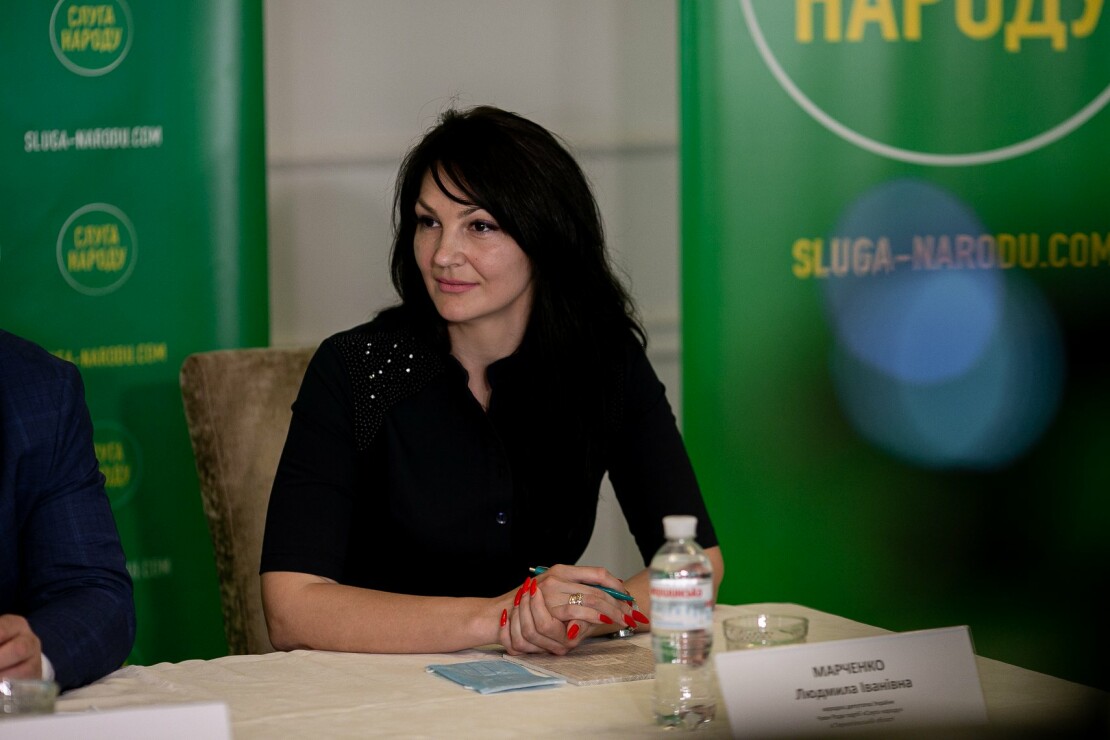


On October 20 and 21, the HACC Appeals Chamber is hearing closing arguments in the case of MP Liudmyla Marchenko, whom the first-instance court found guilty of trading in influence on March 19, 2026. The court sentenced Marchenko and her assistant Anastasiia Kolesnik to 2 years’ imprisonment for allegedly taking a bribe to have two volunteers, Hrytsio and Bondziukh, both men of conscription age, entered into the Shliakh system so they could travel abroad.
Defendant Kolesnik opened the closing arguments. She explained that she handled all the paperwork at the Ukrainian-Turkish Charitable Foundation, including preparing submissions to the Shliakh system. At one point, an acquaintance asked her to enter two volunteers into the system so they could travel abroad. Kolesnik agreed to give them her phone number because she trusted the person who had vouched for them. She said that one of the men, Hrytsio, later handed her money for processing the documents; she kept USD 200 and passed the rest to Marchenko. Kolesnik concluded by asking for a non-custodial sentence, such as a fine.
Kolesnik’s defense counsel claimed that the rules on automated case assignment had been breached at first instance. He argued that the case should have gone to a different panel, because the panel assigned to it had the heaviest caseload when the indictment arrived. For this reason, the lawyer maintains, the court had no authority to hear the case at all.
The defense also called the sentence excessively harsh and disproportionate. The lawyer argued that the court had disregarded a range of evidence, including documents showing that Kolesnik is divorced and raising two young children on her own. On these grounds, defense counsel asked the appellate court to overturn the verdict and order a retrial.
During the arguments, Liudmyla Marchenko maintained that she had set up the foundation for purely charitable purposes. She stressed that she did not know Hrytsio or Bondziukh, had never demanded any unlawful benefit from them, and that the investigation had not gathered a single piece of proper evidence of her guilt.
The MP said the prosecution’s case rests solely on a subjective reading of her personal correspondence with her assistant. Moreover, when questioned at first instance, Hrytsio and Bondziukh themselves could not clearly confirm that a bribe had been demanded or handed over to her or to Kolesnik.
The defendant also emphasized that she had no power at all to grant border-crossing permits. That falls exclusively to authorized state bodies, with which she has no connection.
Marchenko called the criminal proceedings a fabrication commissioned against her and pointed to a number of procedural violations: covert investigative actions conducted against her without proper grounds, breaches of the jurisdiction rules, and the absence of any evidence that she received money. She also addressed her assistant’s admission to receiving money from Hrytsio, saying she did not understand why the information had been distorted, since Kolesnik’s testimony is inconsistent with other facts in the case.
Marchenko closed by asking to be acquitted and for the case to be closed because her actions did not constitute a criminal offense.
Marchenko’s defense lawyers backed the MP, stating that she had never proposed taking a bribe and had received no money. The correspondence between Kolesnik and Marchenko held by the prosecution, they said, shows no intention on either woman’s part to obtain a bribe.
One of Marchenko’s defense lawyers and the prosecutor have yet to deliver their closing arguments.