




In Ukraine’s criminal justice system, bail is one of the most debated interim measures, especially in top-level corruption cases. Contrary to a common belief, bail is not a way to “buy one’s way out of a crime” or a fine. It is a procedural tool designed to ensure that a suspect or defendant does not abscond from the investigation, influence witnesses, or destroy evidence.
What is bail and how does it work?
Bail is one of the interim measures available in criminal proceedings. There are five in total: personal recognizance, personal surety, bail, house arrest, and detention in custody.
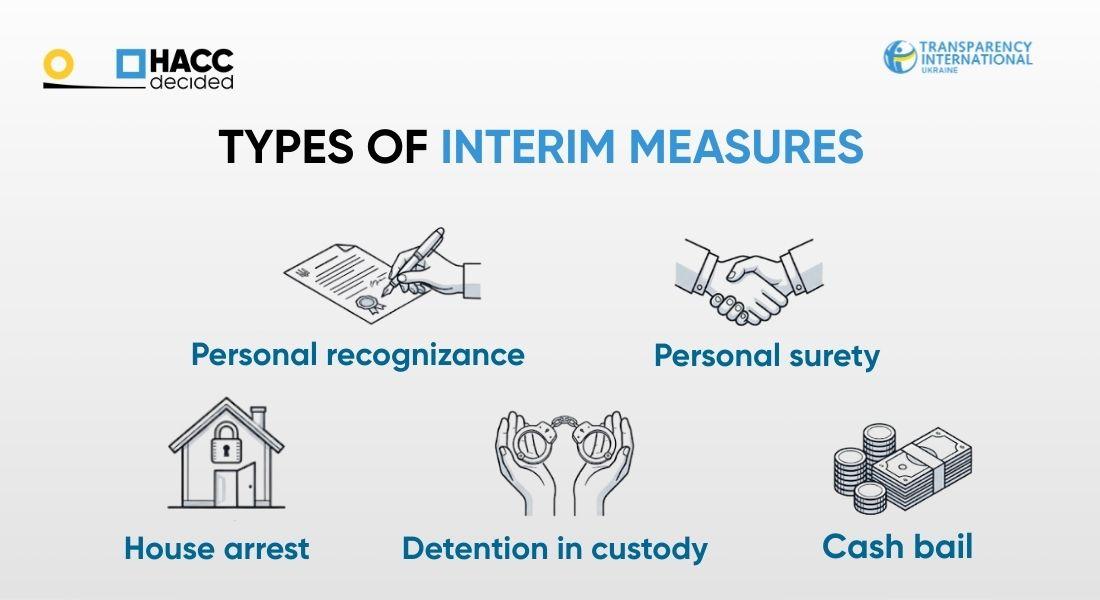
It is a specific legal instrument that may be applied either on its own or as an alternative to detention in custody. In the latter case, the judge orders detention in custody but gives the suspect an opportunity to be released upon payment of the set amount.
The law also provides for cases where the court may order detention in custody without the alternative of bail:
- if the crime involved violence or a threat of violence
- if the crime caused a person’s death
- if the person has already violated the terms of previously imposed bail
- if the crime is connected with criminal organizations (Articles 255–255³ of the Criminal Code of Ukraine) or with especially grave drug-related offenses.
In addition, bail is not set for persons placed on an international wanted list or those located in occupied territory or in the aggressor state. Under martial law, this rule also applies to crimes against the foundations of national security, terrorism, treason, and war crimes (Articles 109–114, 258–261, 402–408, 429, 437–442 of the Criminal Code of Ukraine). Bail is likewise not set where detention in custody is considered at the request of the International Criminal Court.
Bail functions as a “financial guarantee” of the suspect’s proper conduct. The funds are paid into a special account and serve as security for compliance with the obligations imposed on the person. The logic is simple: the risk of losing a substantial amount of money must outweigh any desire to flee or obstruct the investigation.
The bailor may be either the suspect personally or any other individual or legal entity, except for state-owned or municipal enterprises. Bail must be paid into a special account within five days from the date the interim measure is imposed if the person is not held in custody. Where bail is set as an alternative to detention in custody, it may be paid at any time, and the person is released immediately once the funds reach the relevant account.
Procedural obligations
The imposition of bail is almost always accompanied by additional obligations intended to minimize risks to the investigation. These can be grouped into several main categories:
-
Restrictions on movement — a ban on leaving one’s place of residence, surrender of passports and other documents allowing travel abroad, as well as an obligation to wear an electronic monitoring device
-
Restrictions on communication — a ban on contacting witnesses, other suspects, or visiting certain places
-
Discipline requirements — an obligation to appear when summoned by the investigator or the court and to report any change of residence or employment
-
Social correction — in some cases, the court may order the person to obtain employment, begin studies, or even undergo addiction treatment
If the suspect breaches even one of the imposed obligations, the bail may be forfeited to the state. This decision is made by the court either upon the prosecutor’s motion or on its own initiative.
In that case, the person is assigned a new, usually stricter, interim measure or bail in a higher amount. If the bail is not forfeited to the state, it is returned to its owner after the interim measure ceases to apply.
An important nuance is that these funds may be used to enforce the judgment in the part concerning pecuniary penalties: bail posted by the defendant personally may automatically be used to cover damages or a fine, whereas funds posted by a third-party bailor may be used for that purpose only with that person’s voluntary consent.
Amount of bail
A particular feature of bail in corruption cases lies in how its amount is determined. The Criminal Procedure Code sets upper and lower limits for bail depending on the gravity of the offense:
-
non-serious offenses — from 1 to 20 subsistence minimums
-
serious offenses — from 20 to 80 subsistence minimums
-
especially serious offenses — from 80 to 300 subsistence minimums.
However, there are exceptions to this rule: for serious and especially serious offenses, bail may exceed these limits. Corruption offenses usually fall into these categories. In other words, if the court concludes that bail within the limits of 80 or 300 subsistence minimums respectively would not be sufficient to ensure the suspect’s or defendant’s proper procedural conduct, it may set an amount above those thresholds.
When determining the amount of bail, the court must take into account the circumstances of the criminal offense, the person’s financial and family situation, and the procedural risks involved. At the same time, bail must not be excessive for that person.
In a number of rulings, the HACC Appeals Chamber has repeatedly emphasized that setting an amount the person is objectively unable to pay effectively amounts to ordering detention without an alternative, which is contrary to the fundamental principles of criminal justice.
Current practice shows that courts often use the rule allowing bail to be set above the statutory limits, guided by the amount of alleged damages, the size of the improper benefit received, or the person’s overall assets.
Even so, the ECHR has never found Ukraine in violation of its obligations because of the amount of bail set in HACC cases. Moreover, in Alperin v. Ukraine, considered in the context of partial forfeiture of bail, the Strasbourg court held that the defense’s complaints about the allegedly unlawful detention and the subsequent imposition of an interim measure were manifestly ill-founded. The court took into account detectives’ authority to detain a person without an investigating judge’s order in certain cases, as well as HACC’s proper reasoning for its decision to remand Alperin in custody.