


The HACC acquitted Heorhii Popovetskyi, former director of the Khotynskyi National Nature Park, who had been charged with receiving an unlawful benefit on an especially large scale. The HACC Appeals Chamber later upheld the verdict.
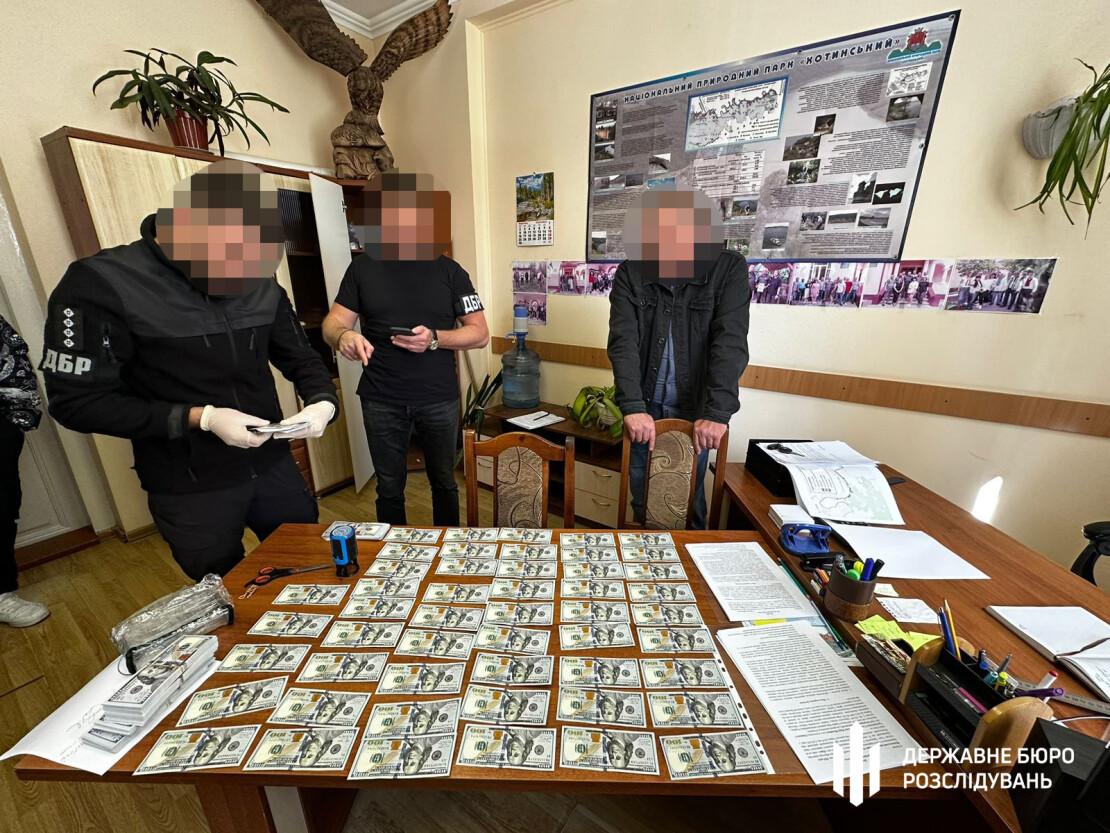
According to the investigation, between July and September 2024, Popovetskyi repeatedly demanded that an “investor,” in fact an SBI agent, provide an unlawful benefit in exchange for concluding agreements on recreational activities. Initially, this involved the construction of two cottages worth about $30,000. The demands later changed: on August 23, 2024, UAH 84,000 was transferred to a contractor’s account for the manufacture of two “api-houses” for the park. According to the investigation, the final stage was a request for $65,000 for signing two more agreements on the use of land plots and for help with repairing a boat. On October 9, 2024, during the handover of this amount (most of the banknotes were imitation), SBI officers detained Popovetskyi in his office.
ПІДПИС: Popovetskyi’s detention. Photo credit: SBI
The defense insisted that the defendant had neither demanded nor received money for personal enrichment. Popovetskyi pleaded not guilty. He claimed that he had acted solely to develop the park and in line with the Ministry of Environment’s instruction to attract investors. He stated that he had seen the “investor” as a wealthy entrepreneur willing to fund recreational projects. He said he had repeatedly stressed that the land could not be sold or leased, and offered only a lawful form of cooperation, in particular building several cottages that would be transferred to the park’s balance sheet as sponsorship aid. Popovetskyi emphasized that he had refused cash as a matter of principle: he had ordered that payment for the first api-houses (UAH 84,000) be transferred directly to the contractor’s account. According to him, he regarded the $65,000 as a cost estimate for building four houses for the park’s needs and repairing the park’s service boat, which the “investor” had allegedly agreed to finance.
According to Popovetskyi, on the day of his detention, the complainant insisted on leaving the package of money in the office. Popovetskyi allegedly did not touch the money himself. He said he asked the complainant for a receipt for a “contribution to the park’s development” and intended to officially deposit the money through the bank together with the accountant the next day.
The defense also argued that the complainant, who turned out to be a “serial witness” for law enforcement, had entrapped Popovetskyi.
The court concluded that the investigation had provided no evidence that Popovetskyi planned to use the funds for himself. Moreover, the court established that the complainant had acted on the instructions of law enforcement. The complainant actively pushed the official to name specific amounts, initiated meetings, and insisted on handing over cash in the office despite proposals to make the payments officially as charitable aid. The case file also contains no evidence that the complainant had any real intention of carrying out recreational activities in the park, which further points to entrapment.
The court paid particular attention to the timing of phone contacts between the defendant and the complainant. These began a month before the complainant officially filed a crime report, which indicates that the agent had been covertly enlisted before any objective suspicion arose. In addition, it emerged that the complainant had repeatedly cooperated with the SBI in 2024. His cover story about being a wealthy investor, buying a factory, and having fictitious sponsors amounted to active incitement.
Heorhii Popovetskyi was charged under Article 368(4) of the Criminal Code.
Ultimately, the HACC acquitted Heorhii Popovetskyi because his actions did not constitute a criminal offense, finding that they were the result of entrapment by law enforcement.
In August 2026, the HACC Appeals Chamber upheld Popovetskyi’s acquittal. The judges agreed with the first-instance court that his actions did not constitute a crime. However, the Appeals Chamber did not find entrapment regarding the unlawful benefit in the form of two api-houses. For the rest of the case, the court agreed that the transfer of $65,000 resulted from entrapment.

 07/04/2025


