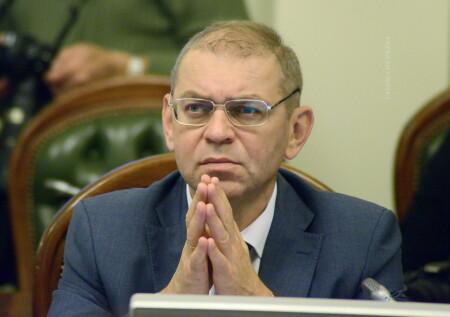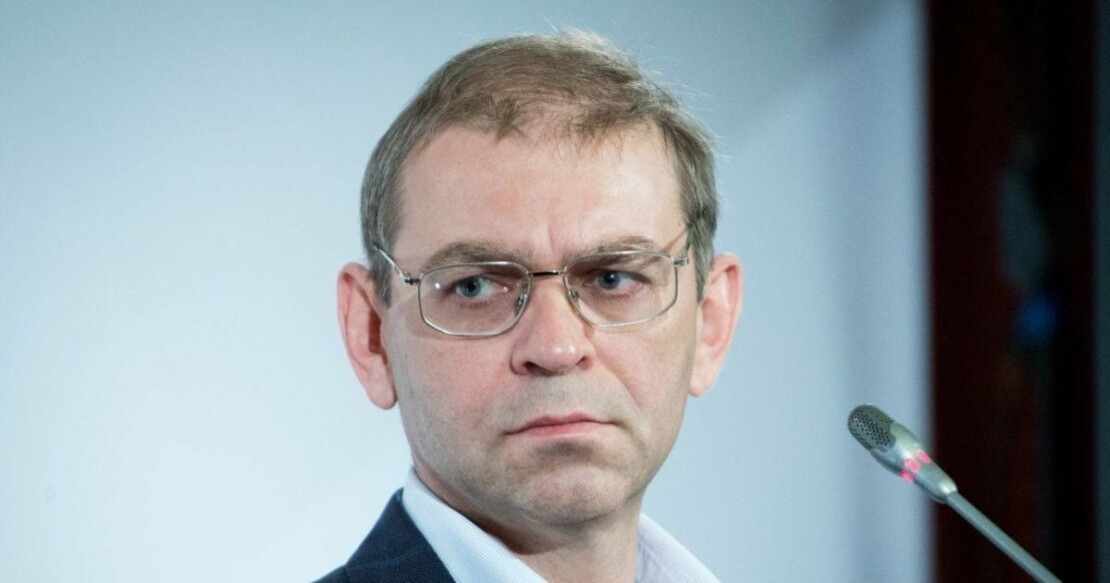
The NABU-SAPO suspect former officials of the state-owned enterprise Ukrtransnaftoproduct and business representatives of participating in a criminal organization and misappropriating “Kurchenko’s oil products” worth nearly UAH 1 billion. The case also involved former Member of Parliament Serhii Pashynskyi (Verkhovna Rada convocations 5–8) and businessman Serhii Tyshchenko, whose plea agreements the HACC has approved.
“Kurchenko’s oil products” are oil products seized in 2014 in the case of Serhii Kurchenko, the owner of the East European Fuel-Energy Company, which were stored at the Odesa Oil Refinery, Kherson Oil Transshipment, and the Vasylkiv Oil Depot. They were planned to be sold under the “interrupted transit” scheme: legally, they were to pass through Ukraine, but instead, they were to be sold there.
Details of the scheme
Seven individuals were served with notices of suspicion:
- Serhii Pashynskyi, former acting Head of the Presidential Administration of Ukraine, Member of Parliament of Ukraine, and head of one of the committees of the Verkhovna Rada of Ukraine;
- Serhii Tyshchenko, businessman, co-owner of the Factor group, and co-organizer;
- Volodymyr Havrylov, former director of the state-owned enterprise Ukrtransnaftoproduct;
- Oleksandr Horbunov, Havrylov’s former deputy;
- Arkadii Kirman, manager at SE Ukrtransnaftoproduct and the Factor business group;
- Oleksandr Buchynskyi, director of the private company Ukroilproduct LLC;
- Andrii Boichuk, former head of the Oil and Gas Complex Department of the Ministry of Energy of Ukraine and former head of the Ivano-Frankivsk RMA.
According to investigators, Serhii Pashynskyi (then head of the Presidential Administration) and businessman Serhii Tyshchenko formed an intent to misappropriate “Kurchenko’s oil products.” Using Pashynskyi’s political influence, the group allegedly established control over Ukrtransnaftoproduct by installing loyal managers.


The legislation in force at the time allowed physical evidence to be sold only where there was a risk of spoilage and only through designated exchange companies, with the proceeds guaranteed to go to the deposit accounts of the pretrial investigation body. To circumvent this procedure and gain direct control over the raw materials, the associates tried to rewrite the regulatory framework to suit state-owned enterprises.
Pashynskyi appointed Tyshchenko’s former wife, Olena Tyshchenko, to a position within the Presidential Administration, and she prepared a draft government decision on transferring physical evidence to state-owned companies. However, although the Cabinet of Ministers approved the draft, then Prime Minister Arsenii Yatseniuk never signed the document.
Having been turned down at the Cabinet of Ministers, the individuals in the case changed tactics and turned to the law enforcement and judicial hierarchy. Control over the fuel was secured through SE Ukrtransnaftoproduct. The investigation into the oil products case was handed over to the Odesa police, whose investigators secured the transfer of the entire volume of fuel to Ukrtransnaftoproduct for safekeeping.
Subsequently, according to the investigation, Havrylov sent a fictitious request to the Ministry of Internal Affairs, citing a non-existent Ministry of Energy order, for permission to sell these oil products. At the same time, under Pashynskyi’s patronage, Tyshchenko was introduced to the leadership of the Main Investigation Department of the Ministry of Internal Affairs as the unofficial overseer of the process on behalf of the state-owned enterprise.
Having gained access to the oil depots, the individuals in the case set up the following money laundering chain:
- SE Ukrtransnaftoproduct signed an agreement to sell all of the seized fuel to the private company Ukroilproduct (headed by Buchynskyi), which was part of the Factor business group controlled by Tyshchenko.
- The price of the oil products was artificially lowered under the pretext of an “urgent sale,” and payment was spread over 2 years. The company then sold the oil products to end consumers at the real market price.
The fuel was sold to Ukroilproduct at an understated price; however, the funds were not transferred to the deposit account of the pretrial investigation body but were instead siphoned off through Itanix Strong LLC, Trade Invest Company LLC, and other companies controlled by Tyshchenko.
Proceeds from the sale were allegedly routed through Fortuna Bank, owned by Tyshchenko’s mother. Funds were transferred to the accounts of Itanix Strong and Trade Invest Company as advance payments for goods, which allowed the criminal organization to control both the fuel and the money at the same time.
To disguise the scheme, detectives allege that Pashynskyi and Tyshchenko attempted to purchase other petroleum products in Belarus and Russia, with the intention of later reselling them to the state at inflated prices.
After Fortuna Bank was declared insolvent in 2017, payments to the state enterprise stopped, and Ukroilproduct LLC was allegedly liquidated through a bankruptcy procedure. As a result, part of the funds disappeared. As a consequence of these actions, the total losses, according to NABU's current data, amounted to UAH 967 million (UAH 817 million taking into account the excise duty paid).
The actions of the individuals in the case were classified under Article 364(2), Article 255(1), and Article 191(5) of the Criminal Code of Ukraine.
Property seizures and attempts to avoid liability
In February and March 2024, HACC investigating judges seized assets registered in the name of Ruslana Pashynska. The couple has been married since 1989, and in March 2013, they signed a prenuptial agreement stating that each spouse’s property is the separate property of the spouse in whose name it is registered.
The court viewed this agreement as an attempt to avoid confiscation, noting that it was concluded 24 years after the marriage and appeared aimed at preventing negative legal consequences in the event of confiscation, given that Pashynskyi is accused of offenses allegedly committed between 2014 and 2018.
The seizure covers half of the assets registered to Ruslana Pashynska: a residential house of more than 1,000 square meters in the village of Lisnyky (including a chapel, a guard house, and a gazebo) and five land plots totaling more than one hectare. A 2022 Mercedes-Benz and two additional land plots were also seized initially, but in October 2024 the HACC Appeals Chamber lifted the seizure from those assets. In May 2025, the court refused to fully lift the seizure from the remaining property.
In addition, in May 2025, the HACC twice granted Pashynskyi’s motions and allowed him to temporarily leave Ukraine to attend the IDET-2025 international defense industry exhibition in the Czech Republic, where he was invited in his capacity as head of the National Association of Defense Industry of Ukraine.
Who entered into plea agreements?
On September 5, 2025, the HACC approved a plea agreement with Serhii Tyshchenko. He received an 8-year prison sentence and a 3-year ban on holding positions in state and local government bodies and at state and municipal enterprises, institutions, and organizations. Tyshchenko was released from serving the principal sentence with a 3-year probationary period. Under the terms of the agreement, Tyshchenko has already transferred UAH 40 million to the Defense Forces of Ukraine and must pay another UAH 110 million to the state budget over the next 3 years.
In December 2025, former Ukrtransnaftoproduct head Arkadii Kirman and Ukroilproduct manager Oleksandr Buchynskyi entered into plea agreements. The court sentenced each of them to 7 years in prison, from which they were released with a 1-year probationary period. In addition, Kirman and Buchynskyi were banned from holding managerial positions for 3 years. Under the terms of the agreements, Kirman and Buchynskyi must each pay UAH 500,000 in compensation to the state budget within 30 days of the verdict entering into force.
In September 2026, the key individual in the scheme, Serhii Pashynskyi, also entered into a plea agreement. Pashynskyi fully admitted his guilt and agreed to give incriminating testimony to the investigation. The plea verdict describes Pashynskyi as a member, not an organizer, of the criminal organization. In the verdicts against his co-defendants, however, his role is likely described differently.
Under the terms of the agreement, the former MP must:
- compensate the state for UAH 600 million in losses, paying the amount into the State Budget of Ukraine in installments over 2.5 years;
- transfer UAH 400 million to the Come Back Alive Foundation or, at the foundation’s instruction, arrange deliveries of weapons worth the same amount to military units within 6 months;
- transfer UAH 100 million to the account of the Sternenko Community Foundation for weapons for the Defense Forces of Ukraine within 30 days;
- pay a UAH 850,000 fine as the principal punishment;
- pay an additional UAH 17,000 fine and be deprived of the right to hold positions in state and local government bodies for 1 year as an additional punishment.