




In 2025, the civil forfeiture mechanism in Ukraine firmly established itself as one of the most dynamic and effective tools for combating public officials’ unjustified enrichment. Civil forfeiture makes it possible to seize officials’ assets when they cannot justify their origin through lawful income.
We previously reviewed and analyzed the specific features of this mechanism in a separate article. Since its publication, we have seen clear evidence that the use of this instrument has expanded significantly. While only 7 claims were recorded in 2023, that number rose to 16 in 2024, and by the end of 2025, the Specialized Anti-Corruption Prosecutor’s Office (SAPO) had filed as many as 45 civil forfeiture claims. That is three times more than during the previous five years combined, pointing to a shift from isolated precedents to the systematic use of this mechanism, as well as to the emergence of stable court practice.
To briefly recap, the key feature of this mechanism is that a criminal conviction is not required to recover property. The state may initiate the forfeiture of an official’s assets through civil proceedings if that official fails to prove their lawful origin.
The process is initiated by SAPO before the High Anti-Corruption Court (HACC). Suspicious wealth, meanwhile, may be identified by a range of bodies, including the NACP, NABU, SAPO, the SBI, and the Prosecutor General’s Office.
In the summer of 2025, the asset value thresholds for civil forfeiture changed. Under the law of June 17, 2026, such claims may now be filed with respect to assets worth at least UAH 1.5 million, whereas the previous threshold was just over UAH 1 million. At the same time, the upper threshold is dynamic: in 2026, it stands at UAH 9.98 million, although under the previous rules it would have been UAH 10.8 million for 2026.
HACC сivil forfeiture rulings in 2025
Overall, since the introduction of this mechanism in 2019, the HACC has considered 39 cases on recognizing assets as unjustified, including 19 in 2025 alone. Below, we examine the most illustrative cases showing what kinds of assets, and through which schemes, the state is now recovering into public ownership.
An analysis of court registry data for 2025 shows a significant expansion in the geographic spread of claims, as well as a much broader “profile” of defendants—from heads of settlement councils to members of parliament and deputy ministers.
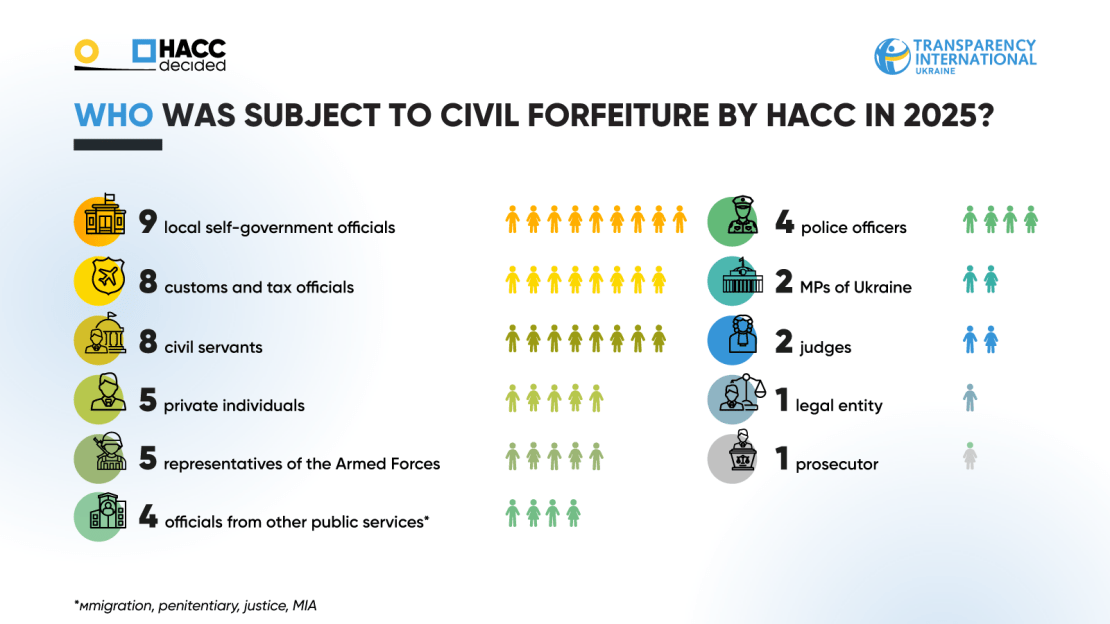
The breakdown of defendants shows that in 2025, SAPO targeted representatives of nearly all branches of government and oversight bodies. In particular, a significant number of claims concerned employees of the border guard and customs services, officials of executive authorities, and representatives of local government.
Case of the former head of the Carpathian District Environmental Inspectorate
A telling example is the case of Mykola Ladovskyi, the former head of the State Environmental Inspectorate of the Carpathian District, whose assets worth nearly UAH 20 million were targeted for forfeiture.
In January 2026, a panel of HACC judges fully granted SAPO’s claim, finding three apartments and a non-residential property in central districts of Ivano-Frankivsk to be unjustified assets and ordering their recovery for the benefit of the state, along with two premium vehicles—a 2021 Volkswagen Touareg and a 2023 Mercedes-Benz G 63 AMG.
Although all of this property was formally registered in the names of the official’s relatives and other third parties, anti-corruption bodies, relying on materials from the SBI and the NACP, proved that the official income of the nominal owners could not have supported such major acquisitions.
A key feature of this case was that the civil claim was considered and granted after Mykola Ladovskyi’s death and after the criminal proceedings against him had been closed. This confirms the autonomous nature of civil forfeiture.
Case of the Odesa customs family
A vivid example of “family” corruption was the case about the Odesa customs family of Serhii and Halyna Hrynchyshyn, as well as their son, Serhii Hrynchyshyn, who serves as deputy head of one of Kyiv region’s district councils. Across two claims, SAPO succeeded in proving that the officials’ family had unjustified assets worth more than UAH 8.7 million in total.
The scheme was a classic one: in 2021, the married couple, both employees of Odesa Customs, purchased an apartment in Odesa (103.8 sq. m), while their son bought a spacious apartment in Kyiv (105.5 sq. m) and a Toyota RAV4 Hybrid. All of these multimillion-hryvnia assets were formally registered in the name of a close relative born in 1937. However, an income analysis showed that neither the pensioner nor the officials themselves had lawful funds to make investments on that scale.
Notably, once the NACP began monitoring their lifestyle, the relatives rushed to sell off all of the questionable assets. But that did not help them avoid liability. Since the assets were no longer owned by the defendants, the HACC applied the mechanism for recovering their monetary value.
Case of a Member of the Velyka Dymerka Settlement Council
No less significant was the case of Oleh Tkachenko, a member of one of the settlement councils in Brovary district, Kyiv region, from whom HACC forfeited assets worth more than UAH 5 million.
This case is notable because the initial trigger was not anti-corruption monitoring, but criminal proceedings related to environmental offenses. It was during that investigation that prosecutors discovered a clear mismatch between the council member’s lifestyle and his official income. At the center of the investigation was a true land “empire” and a fleet of high-end vehicles registered in the names of the official’s ex-wife, adult son, and mother-in-law.
Specifically, the court found the following assets to be unjustified and ordered them recovered for the benefit of the state: a 2023 Volkswagen ID.4 electric vehicle worth more than UAH 1 million, registered in the ex-wife’s name; a 2015 Jaguar XF registered in the son’s name; and more than 10 land plots of various sizes, some of which were owned by the council member's mother-in-law.
A distinctive feature of the case was the relatives’ attempt to quickly “dispose of” the assets: the mother-in-law managed to sell part of the land plots to persons close to the family. However, thanks to SAPO prosecutors’ swift response in seeking a court-ordered asset freeze, further disposals were stopped.
Ultimately, the court ordered not only the forfeiture of the remaining property, but also monetary recovery from the relatives for the assets already sold (around UAH 500,000 in addition to the confiscated property). This case once again shows that a sham divorce or registering assets in relatives’ names is no longer a reliable shield from the close scrutiny of anti-corruption bodies.
Case of an official from the Main Department of the State Tax Service in Ivano-Frankivsk Region
A separate place in the 2025 court practice belongs to a case that became one of the few examples in which anti-corruption bodies failed to prove that the assets were unjustified, both at first instance and on appeal.
The claim concerned Nataliia Bendas, head of the Tax Audit Department of the Main Department of the State Tax Service in Ivano-Frankivsk region, from whom SAPO sought to forfeit a BMW iX xDrive40 electric vehicle worth nearly UAH 2.8 million. According to the prosecutors, the car was only formally registered in the name of the husband of the official’s niece, while in reality it was controlled by her family. The claimants’ main evidence included a general power of attorney issued to the official’s husband, the results of an SBI search during which his documents were found in the vehicle, and a key card for the car discovered in the family’s apartment. In addition, a BMW charging device was found in non-residential premises owned by the official, while surveillance cameras captured the car traveling along routes normally used by her family.
However, HACC sided with the defendants, reasoning that the prosecutors had failed to prove the key criterion: the official’s actual connection to the asset. The court found that the nominal owner had actively participated in maintaining the vehicle, personally opened it with his own key during the search, and gave explanations. The witness testimony of condominium association neighbors also proved inconsistent: they confirmed seeing the official’s husband driving a BMW, but described a completely different, smaller gray model that did not match the asset in dispute.
The court also found the NACP’s evidence inadmissible because the agency had monitored the lifestyle of a person who was not subject to asset declaration requirements, thereby violating the established procedure for collecting information. Ultimately, the HACC concluded that the prosecutor had not provided a clear calculation of the difference between income and expenditures, but had merely assumed the existence of hidden funds. Since the status of the “proper defendants” and the fact of indirect ownership had not been duly proven, the court dismissed the claim. The appellate instance later upheld that ruling, leaving the property in the ownership of the official’s relatives. SAPO is currently challenging both the first-instance judgment and the appellate ruling before the Civil Cassation Court of the Supreme Court.
The geography of luxury: What is the state recovering?
The range of assets subject to recovery is striking in its variety. They include:
-
Premium-class vehicles. In addition to the brands mentioned above, 2025 claims involved a Porsche Cayenne worth more than UAH 5 million, an Audi RS Q8, a Land Rover Range Rover Vogue worth UAH 3.2 million, and even a Volvo XC90
-
High-end real estate in the capital. This includes apartments in prestigious residential complexes in Kyiv, such as one in Comfort Town owned by a department head at the Department for Combating Drug Crime, residential houses exceeding 200 square meters in the regions, and, of course, numerous land plots
-
Water transport. This includes a Sylvan Mirage Cruise self-propelled pleasure boat worth nearly UAH 1 million, which was forfeited from the head of a settlement council in Rivne region. Another similar asset, a Bayliner 245 SB boat worth UAH 800,000, is still the subject of forfeiture proceedings against former head of the Darnytskyi District State Administration in Kyiv, Yaroslava Lahuta.
The amounts claimed in 2025 ranged from the minimum necessary to open proceedings to several million hryvnias. One of the largest claims concerns MP Liudmyla Marchenko, against whom SAPO filed a claim in September 2025. This case is one of the largest in terms of the number of real estate assets simultaneously involved in civil forfeiture proceedings. Anti-corruption bodies targeted an entire “collection” of assets acquired in 2021–2023: five apartments, property rights to another apartment, and a Toyota Land Cruiser. The total value of the property is more than UAH 8.2 million. According to the claimant, the assets were registered in the names of close associates—the MP’s father and her brother’s cohabiting partner—to conceal the true owner. However, an analysis of the entire family’s financial situation showed that none of the relatives had lawful income sufficient for such acquisitions. The case is currently pending before the HACC. It is notable not only because of the defendant’s status, but also because it demonstrates how the civil forfeiture mechanism works in relation to property dispersed among several trusted persons.
Defendants often tried to conceal property by registering it in the names of relatives—parents, mothers-in-law, or wives. However, courts are increasingly applying the concept of “indirect ownership,” recognizing that the official in fact uses the asset and gives instructions regarding its acquisition or disposal.
The appeals process in 2025 became longer and more complex: defendants increasingly sought to delay proceedings as much as possible or find grounds to overturn forfeiture decisions by challenging HACC rulings first before the HACC Appeals Chamber and then before the Civil Cassation Court.
Conclusion
In the end, 2025 showed that civil forfeiture has ceased to be an “experimental” tool and has become an integral part of Ukraine’s anti-corruption architecture. The myth that assets can be securely hidden by registering them in the names of third parties has now been decisively shattered. HACC judicial practice has made one thing clear: the burden of proving the lawful origin of assets now rests with the official, and a mismatch between lifestyle and lawful income is a direct ground for recovering those assets for the benefit of the state.
In addition, this body of case law is now undergoing meaningful review at the Supreme Court level, which helps ensure consistency and a stable, coherent line of development.
The state plans to further refine this tool. In particular, as we previously noted in the Shadow Report and in separate studies, EU Directive 2024/1640 provides for an expanded scope of civil forfeiture. There are also certain challenges related to its use where a person is acquitted in criminal proceedings.
The draft Anti-Corruption Strategy addresses some of these shortcomings. At present, it proposes expanding the range of persons subject to this mechanism, as well as allowing such claims to be filed for amounts exceeding the established threshold where an illicit enrichment case has been closed. In addition, it proposes expressly establishing in law that the entry into force of a court decision on civil forfeiture is an unconditional ground for dismissal from public service.
Even so, there is still no reliable information on the enforcement of these court decisions. The next stage in the development of this mechanism should therefore include, among other things, the creation of a transparent enforcement system that will turn legal provisions into actual budget revenues.
This material is prepared by the Transparency International Ukraine team
This publication was prepared within the framework of the “Digitalization for Growth, Integrity, and Transparency” (UK DIGIT) project, implemented by the Eurasia Foundation and funded by UK Dev. The material was produced with the financial support of the UK Government’s International Development Assistance Programme. The contents of this material are the sole responsibility of Transparency International Ukraine; the views expressed do not necessarily reflect the official policy of the Government of the United Kingdom.
.png)
.png)
.jpg)
.png)
.png)
.jpg)

.jpg)
.png)
.png)

.png)
.png)
.png)