

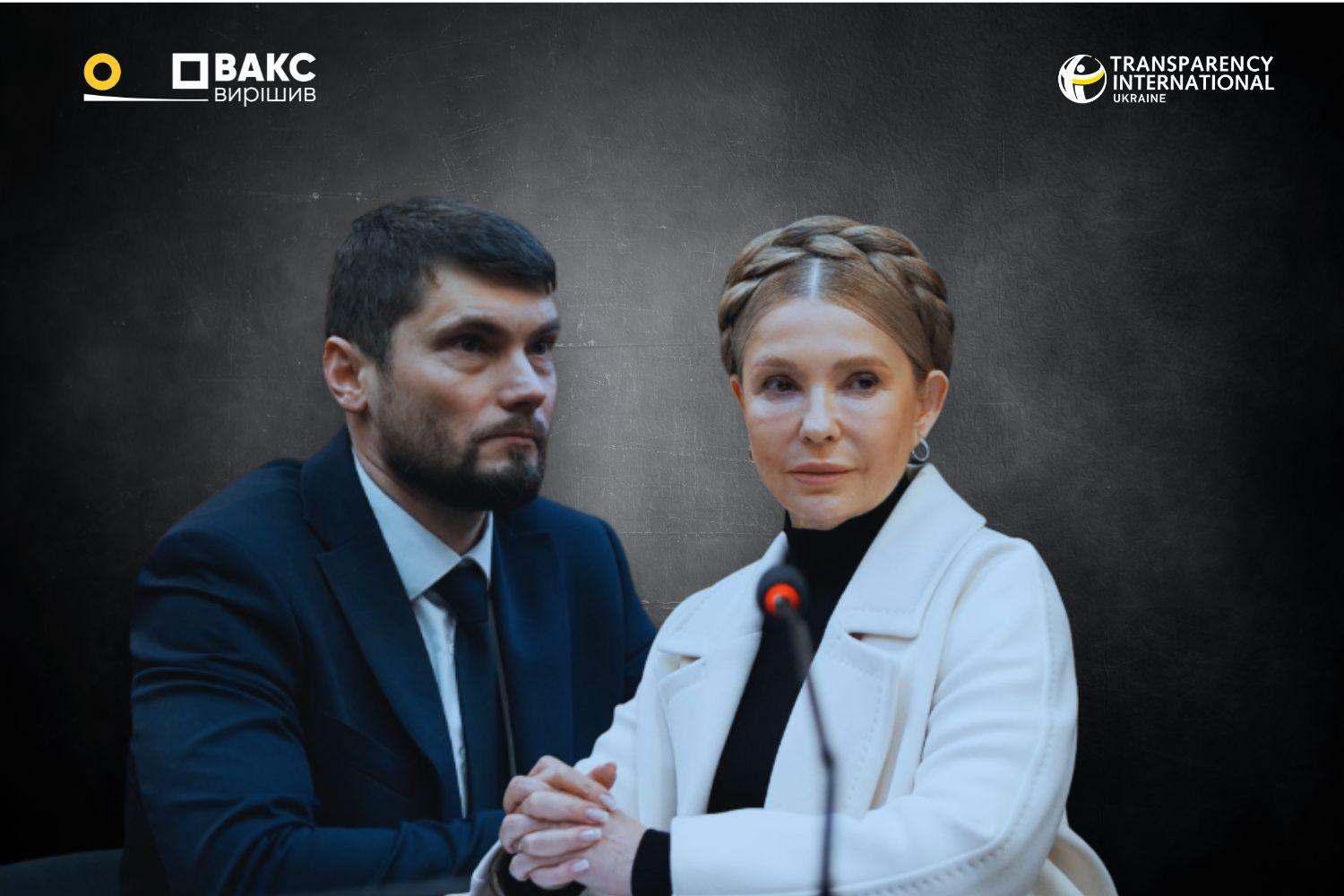


On January 26, 2026, the HACC Appeals Chamber reviewed the interim measure imposed on Yuliia Tymoshenko, the leader of the Batkivshchyna parliamentary faction, who is suspected of attempting to bribe members of parliament. Tymoshenko and her defense continued to insist the case was politically motivated, but still did not name who they claim ordered it. The panel of HACC Appeals Chamber judges asked the SAPO prosecutor, Vitalii Hrechyshkin, a number of questions about how the case is being investigated. These included why investigators did not wait for an actual transfer of an unlawful benefit, what the amount of bail is based on, why the prosecution sought a ban on communicating with sixty-six MPs, and other issues.
In this piece, we highlight the key points from the SAPO prosecutor’s answers to the HACC Appeals Chamber judges.
On suspicion for offering a bribe, not for paying it
Yuliia Tymoshenko is suspected of offering bribes to MPs in exchange for “needed” votes in the Verkhovna Rada. According to the investigation, this was not about one-off arrangements, but about building a systematic mechanism of cooperation intended to operate over a long period: an amount of $10,000 per MP was discussed, in exchange for voting in line with received instructions.
That is why many people wondered why the detectives did not wait for the moment the money was actually handed over, and instead announced the suspicion after recording the relevant conversations between Tymoshenko and another MP. This is exactly what the HACC Appeals Chamber judges asked the panel.
Presiding Judge Mykola Hlotov: “You are conducting an investigation and establishing the information you have just made public. Why didn’t you wait for the fact of at least one transfer—at least one handover? What was the reason? In other words, as soon as there was an offer, you immediately carried out the operation. Why?”
Prosecutor: “The offense was completed the moment the offer was made, so we had every legal ground to serve the notice of suspicion.”
The well-known conversation involving Tymoshenko took place on January 12, and already on January 14, NABU detectives searched her office.
A bit later, the presiding judge followed up with the prosecutor:
Presiding Judge Mykola Hlotov: “You say you recorded the fact and therefore had the ability to serve a notice of suspicion. In that situation, what role was Ms Tymoshenko playing—an intermediary, or the person providing the unlawful benefit? Or was someone else supposed to provide it, but effectively through her hands? If so, why did you immediately move to the search, the notice of suspicion, and the interim measure? Weren’t you interested in identifying who ordered it?”
Prosecutor: “The covert investigative actions report you have right in front of you clearly records a conversation in which Ms Tymoshenko says: “I’ll give it to you tomorrow.” Meaning, she is the one who would provide it. As for the origin of this money and the third parties in whose interests the actions were to be carried out through the use of power and official position—that is a matter of pre-trial investigation tactics and methods. Given that we moved into the open phase only ten days ago, I have no desire whatsoever to lay out for the entire country my intentions—how exactly I plan to expose and investigate those sources.”
Presiding Judge Mykola Hlotov: “I’m asking why you didn’t do it.”
Prosecutor: “Because that was in the interests of the pre-trial investigation. We chose this investigative strategy, and the investigation is ongoing.”
On banning Tymoshenko from communicating with 66 MPs
In addition to cash, phones, and computer equipment, investigators found in her office a list of sixty-six MPs from different factions, with plus/minus marks next to their names. According to the investigation, these marks may indicate who agreed to Tymoshenko’s offer and who did not. SAPO therefore argues it is appropriate to bar the MP from personal communication with these lawmakers, to prevent her from influencing them. The first-instance court imposed such a restriction as part of the interim measure. The HACC Appeals Chamber judges raised several questions about this—most importantly, whether such a ban could interfere with the suspect’s ability to perform her parliamentary duties. The presiding judge also asked why there was no ban on communicating with an MP referred to as “Mazur,” since that name appeared in the case materials.
Presiding Judge Mykola Hlotov: “Look: in the motion seeking an interim measure, there is mention of an MP named Mazur and two other MPs. But in the request section—where you ask to ban communication with sixty-six MPs—I don’t see Mazur, and it’s not clear who the other two MPs are. So I’d like to clarify: where is Mazur on the list, and if he isn’t there, where is the reasoning? And why these MPs specifically, and not some others?”
Prosecutor: “As for MP Mazur: that is not this person’s real name, which is why you did not see that surname in the list of persons with whom communication must be prohibited. That is the first point.
Second, as to these sixty-six MPs—if you carefully analyze the content of the covert investigative actions report, there are ample grounds to say that Ms Tymoshenko intended to involve as many people as possible in unlawful activity, including individuals outside her own faction. During the search of Ms Tymoshenko’s office, mobile phones and computer equipment were seized—there is a relevant search record dated January 14, 2026, at your disposal. On the computer equipment and mobile phones, a number of lists were found, including lists relating to the Servant of the People party and other political forces, with people’s names arranged in tables and marked with pluses and minuses. Therefore, there are grounds to believe these were the very individuals who were in Ms Tymoshenko’s sights at the time the criminal offense was committed. And to prevent the risk of obstructing the criminal proceedings by other means, we raised the issue of prohibiting communication with these individuals.”
Presiding Judge Mykola Hlotov: “I understand your answer. But your motion does not say “refrain from communicating about the circumstances of the alleged offence”—it says “refrain from communicating,” full stop. So how do we strike the balance here, with that approach, between the need for Yuliia Tymoshenko to carry out her parliamentary functions and the need to safeguard the investigation?”
Prosecutor: “This issue was raised in the first-instance court. Why is it important, in our view, to prohibit communication entirely, rather than only as to the substance of the suspicion served? Because the offense has already taken place, but there are stated risks of obstructing the criminal proceedings by other means and of committing another criminal offense. Objectively, it is impossible to record communication between Ms Tymoshenko and another MP—this could involve witness testimony, mobile connection data, and so on. But we, as the prosecution, cannot objectively control the content of those communications or determine whether they would relate to the substance of the suspicion or not. Therefore, to neutralise the risk of another criminal offence, specifically, the bribery of one of these MPs, we are asking for an absolute ban on communication with them. In our view, this will not affect Ms Tymoshenko’s work as a Member of Parliament of Ukraine, because this is not about attending the Verkhovna Rada chamber or working in committees, but about direct communication with the specified MPs.”
Presiding Judge Mykola Hlotov: “Understood. You say communication in committees or in the chamber won’t be affected—but what about Ms Tymoshenko's speaking from the rostrum and addressing, among others, these very MPs? In your view, is that “communication”? I’m asking because, hypothetically, she gives a speech from the rostrum and then you come back to us and say, “Forfeit the bail to the state, because she communicated with them.” So I have to ask: is that communication or not? And in that context, my second question: discussion with MPs in a committee—is that communication or not? And do any of these MPs sit on the committee where Yuliia Tymoshenko works?”
Prosecutor: “You are right, Your Honor: if there is communication with any of these MPs, we, as the prosecution, may treat it as a direct breach of the procedural duty regarding communication, and we would be entitled to raise that issue before the investigating judge. Then we would have to prove to the investigating judge whether the duty was breached or not. I can say in advance that a speech at a plenary sitting of the Verkhovna Rada would not be regarded by us as a breach of the duties. But if Ms Tymoshenko were to step out of the chamber and be alone with an MP and communicate with him, that would be treated as a breach.”
Presiding Judge Mykola Hlotov: “Look, I’ve had some experience drafting certain acts, and there was communication within a working group. In substance, that’s the same as communication in a committee. How are you going to monitor that communication? In what way? Will a detective follow Ms Tymoshenko into the committee room, sit there—how exactly?”
Prosecutor: “Your Honors, we are not going to disclose our methods of monitoring.”
Presiding Judge Mykola Hlotov: “I didn’t mean the methods. I meant this: won’t the ban imposed by the investigating judge harm a MP's ability—as a member of a committee or commission—to perform professional duties?”
Prosecutor: “In my view, the scales of justice have to weigh, on the one hand, the threat and the existing risks of committing another criminal offense or obstructing the criminal proceedings, and on the other, the powers of an MP. We have no intention of restricting her political activity or in any way blocking her work in the Verkhovna Rada. But there is a circle of people who attracted Ms Tymoshenko’s attention and were marked in her working documents with notes that can objectively indicate there were also intentions to engage in unlawful actions in relation to them. How do we neutralize that? How do we prevent it?”
Later in the hearing, another member of the HACC Appeals Chamber panel, Viktor Pankulych, returned to the issue.
Judge Viktor Pankulych: “So, the restriction on communication with sixty-seven MPs [in fact sixty-six—the judge misspoke — ed.]. What is that for? To uncover this offense, or to ensure Ms Tymoshenko does not commit another offense in relation to them?”
Prosecutor: “So that we can conduct the pre-trial investigation under conditions where Ms Tymoshenko will not obstruct us.”
Judge Viktor Pankulych: “Sixty-seven [sixty-six — ed.]—is that to uncover it, or so that she doesn’t commit another offense in relation to them?”
Prosecutor: “Including so that she does not commit another offense in relation to them, and so that we can question such persons and check whether there have already been any contacts—whether any offenses have taken place or not.”
Judge Viktor Pankulych: “Go ahead and question them. Let her talk to them, and you can question her.”
Prosecutor: “There could be unlawful influence—pressure to give testimony or to refuse to testify, to give distorted testimony; she could offer them an unlawful benefit. There are grounds to say that providing an unlawful benefit to other MPs was being planned. There are lists of these MPs.”
Ultimately, the HACC Appeals Chamber upheld the defense’s appeal on this point and lifted the ban on communicating with MPs, as well as the ban on leaving Kyiv and Kyiv Region without the investigators’ permission.
On the purpose Tymoshenko allegedly pursued, according to the investigation
As follows from the case materials, the MPs were to be given specific instructions on how to vote on particular agenda items—“for,” “against,” abstain, or not take part in the vote. The arrangements allegedly covered not only draft laws, but also parliamentary staffing decisions: coordinating votes to dismiss certain officials, as well as abstaining or not participating in votes on their appointment. Under the discussed tactic, draft laws would first be placed on the agenda and later “failed” during consideration on the merits—allegedly to block undesirable initiatives.
The HACC Appeals Chamber judges asked the prosecutor what goal, in the investigators’ view, the suspect was pursuing—in other words, what she needed this for.
Judge Viktor Pankulych: “Tell me, please, did I understand correctly: you suspect that Ms Yuliia Tymoshenko offered three MPs—or proposed to give them—$10,000 per month for certain votes?”
Prosecutor: “Correct as regards the fact that she proposed making monthly payments—but she did not pay, at least we have no evidence of any payments. We also did not impute a “promise,” because a promise requires certain elements, and those are not present in this conversation. What we have is a clear offer.”
Judge Viktor Pankulych: “So she offered three MPs $10,000 a month for votes, for a year?”
Prosecutor: “For an unlimited period.”
Judge Viktor Pankulych: “As long as they vote, they keep getting $10,000?”
At that moment, the suspect herself tried to step into the exchange between the judges and the prosecutor. “There is not a single mention of dollars there, Your Honor,” Yuliia Tymoshenko said. The presiding judge reprimanded her, and his colleague continued questioning the prosecutor.
Judge Viktor Pankulych: “Mr Prosecutor, in whose interests was she doing this? Because the giving or offering of an unlawful benefit has to be either in the interests of the person who offers it, or in the interests of a third party. I wonder: in whose interests was Yuliia Tymoshenko acting?”
Prosecutor: “The answer is set out in the notice of suspicion, which states: “in her own interests, and also in the interests of third parties”—that is, for actions carried out in her interests and in the interests of third parties.”
Judge Viktor Pankulych: “I’m reading this article [Article 369 of the Criminal Code of Ukraine], and I want to understand in practical terms: who was she trying to please—herself or third parties—by offering MPs this unlawful benefit?”
Prosecutor: “I cannot reproduce the report verbatim, but it was about bringing down the majority in the Verkhovna Rada.”
Judge Viktor Pankulych: “She offered three MPs money to vote for the collapse of the majority in the Verkhovna Rada. Did I hear you correctly?”
Prosecutor: “Your Honor, we documented three, but the substance of the conversation indicates there were supposed to be many more.”
Judge Viktor Pankulych: “Right—but vote for what exactly? A law? Something else? What was it that would “collapse” it?”
Prosecutor: “According to the covert investigative actions report, Ms Tymoshenko said that before a vote, instructions would be given on how to vote on a draft law or the relevant resolution. This concerned both personnel appointments and relevant draft laws, including those submitted and initiated by the Batkivshchyna political force.”
On why SAPO sought UAH 50 million bail, and in whose interests Tymoshenko allegedly acted
Back in the first-instance court, the SAPO prosecutor asked for UAH 50 million in bail for Yuliia Tymoshenko. However, the investigating judge, Vitalii Dubas, set bail at UAH 33.3 million. The prosecutor then appealed, asking the HACC Appeals Chamber to revise the amount and set bail at UAH 50 million.
Judge Ihor Panaid: “I would still like to hear from you in more detail why UAH 33 million does not satisfy you. You say it could be split among a certain number of people. But if UAH 50 million is also split, will the risks be neutralized? What will you do then?”
Prosecutor: “We proceeded from the officially declared financial situation. It turns out that, as of the end of 2024, Ms Tymoshenko had UAH 15 million in cash; her husband had UAH 28 million; and an additional USD 4 million had been loaned to a third party. We were not asking for the entire total amount of officially declared income; we proceeded from the view that the bail amount must be a proper deterrent. The Tymoshenko family effectively holds UAH 43 million in cash on hand, and USD 4 million is loaned to third parties.
At the same time, we know she intended to provide, on a systematic basis, USD 10,000 to one MP. What is the stated origin of these funds? What are their sources? How systematic is it? Over what period? And is it USD 10,000 for everyone—or perhaps more, or less? All this also points to the existence of other, undeclared income. The version that Ms Tymoshenko intended, using her official income, to systematically provide unlawful benefits to as many MPs as possible each month looks doubtful.
Therefore, given her property status and the nature of the offense—namely the systematic provision of unlawful benefits—it is worth noting that not long ago the NABU and the SAPO exposed other MPs, from another political force, for receiving unlawful benefits in the amount of USD 5,000 per month. Here, as a way to win people over, an amount twice as high is being offered—USD 10,000. So, taking into account these circumstances—declared assets and the sources of funds—we determined that UAH 50 million would be a proper deterrent.”
Judge Ihor Panaid: “Which risk is this meant to neutralize?”
Prosecutor: “All five risks are objectively relevant at this stage: the risk of absconding; the risk of influencing other persons—you can see that the number of people to be checked is objectively large; and the risk of destroying or tampering with objects and documents. In fact, only an urgent search of the office premises and a vehicle has been carried out so far. The investigation is still ahead; there are further investigative steps planned; further ways to locate other evidence, including in electronic form. We are working through that.”
Judge Viktor Pankulych: “Life has a saying: “he who pays calls the tune.” You brought this question on yourself, and it just occurred to me. You, Vitalii Viktorovych, emphasised the origin of the funds and said Tymoshenko wouldn’t pay any MP her own money for voting. So was she offering MPs not her own money to vote for a law? I understand it makes no difference what the unlawful benefit is—her money or someone else’s. But from the perspective of “he who pays calls the tune,” meaning: in whose interests? I’m asking in that context, because as I understand it, whose money it is, that’s whose interests. So: was it not Tymoshenko’s own money that she was offering MPs?”
Prosecutor: “Look, at the time the criminal proceedings were registered—on November 27, 2025—two articles were registered: 368 and 369—giving and receiving an unlawful benefit. At present, we do not know the source of these funds with certainty—the primary source, where they came from. I can only say we have a lot of work ahead of us on that.”
This material is prepared by the Transparency International Ukraine team
This publication was prepared within the framework of the “Digitalization for Growth, Integrity, and Transparency” (UK DIGIT) project, implemented by the Eurasia Foundation and funded by UK Dev. The material was produced with the financial support of the UK Government’s International Development Assistance Programme. The contents of this material are the sole responsibility of Transparency International Ukraine; the views expressed do not necessarily reflect the official policy of the Government of the United Kingdom.

.png)
.png)

.jpg)

.png)
.png)
.jpg)




.jpg)

.png)

.png)


.png)
.png)
.png)