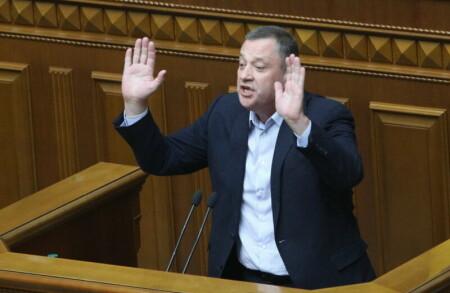


The HACC has closed, for the second time, the case charging MP Yaroslav Dubnevych and eight others with misappropriating Ukrzaliznytsia funds — citing the “Lozovyi amendments.”
According to the investigation, they organized a scheme under which a branch of Ukrzaliznytsia bought turnout products at inflated prices through two intermediary companies, one of which is beneficially owned by Dubnevych.
The following were served with notices of suspicion in the case:
- Yaroslav Dubnevych, MP of the Verkhovna Rada of the 7th, 8th, and 9th convocations, representing UDAR, the Petro Poroshenko Bloc, and the For the Future party
- Eduard Pushkarenko, former assistant to Dubnevych and First Deputy Head of the Production Support Center branch of Ukrzaliznytsia
- Serhii Taranenko, Chairman of the Board, Director General, and co-owner of Dnipropetrovsk Railway Switch Plant PJSC
- Valerii Kriachko, Deputy Director General and co-owner of Dnipropetrovsk Railway Switch Plant PJSC
- Anton Shevchenko, former founder of Argo LLC — the sham company that won the tender
- Oleh Misionh, director of Corporation KRT LLC — a company owned by Dubnevych himself
- Andrii Stepanenko, former head of the track superstructure department at the Production Support Center branch of Ukrzaliznytsia
- Tetiana Klepak and Oksana Zakharevych, employees of that department.


What is the case about, and how did the scheme work?
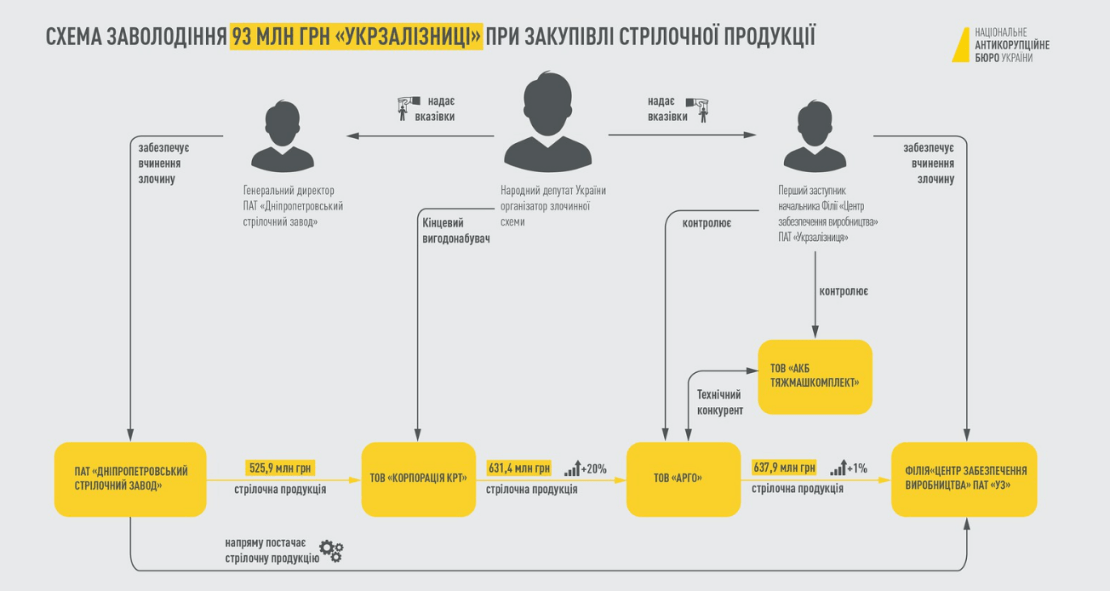
According to the investigation, Yaroslav Dubnevych, using his status as head of the Verkhovna Rada's transport committee and his influence, had significant sway over Ukrzaliznytsia's management. Investigators believe he effectively lobbied for the allocation of Ukrzaliznytsia funds to procure railway turnouts and spare parts for them, and then, together with the people he had brought in, organized the procurement of these goods at inflated prices from Argo LLC, which was under his control.
Eduard Pushkarenko, the MP's former assistant, who at the time held a senior position at the relevant Ukrzaliznytsia branch, was brought into the scheme. He coordinated the preparation of tender documentation through his subordinates Klepak, Stepanenko, and Zakharevych so as to secure victory for Argo LLC. The firm AKB Tiazhmashkomplekt also took part in the sham tender worth UAH 562 million, playing the role of a stand-in competitor.
Dubnevych also turned to Serhii Taranenko, Director General of the Dnipropetrovsk Railway Switch Plant, who was likewise his assistant.
The supply chain was artificially complicated: instead of a direct contract between Ukrzaliznytsia and the Dnipropetrovsk Railway Switch Plant, the goods were sold through a chain of intermediaries. First, the plant sold the goods to Corporation KRT, owned by Dubnevych himself, for UAH 525.9 million. The price then rose by 20% when the goods were resold to Argo for UAH 631.4 million. Argo LLC resold the goods to Ukrzaliznytsia for UAH 637.9 million (+1%).
An expert assessment established that Ukrzaliznytsia suffered UAH 93.28 million in damages by ignoring the option of buying directly from the manufacturer. The participants in the corruption scheme divided the illegally obtained funds among themselves:
-
UAH 6.37 million remained in Argo LLC's accounts and was reportedly the reward for Eduard Pushkarenko and Anton Shevchenko
-
UAH 89 million remained in Corporation KRT LLC's accounts, which Yaroslav Dubnevych and Oleh Misionh used at their own discretion, in particular by transferring it to the accounts of sham companies.
The defendants were charged under Article 191(5) of the Criminal Code of Ukraine. Anton Shevchenko is additionally charged under Article 205(1) and Article 366(1); Pushkarenko, under Article 205(1); and the three Ukrzaliznytsia branch employees, under Article 358(3) of the Criminal Code of Ukraine.
The attempt to bribe detectives and NABU's sting operation
According to the investigation, the participants in the scheme wanted to extend the contract for another year, which would have allowed them to supply a further 20% of the products at inflated prices. But in the summer of 2016, these procurements came into the focus of NABU detectives, forcing the defendants to act more cautiously. They spent a long time agreeing on the terms for extending the contract into the following year, as it was necessary to coordinate with Dubnevych. The scheme's participants thus planned to repeat the crime a year later. The covert investigative materials gathered by the detectives indicate that every decision was coordinated with Dubnevych.


When NABU detectives launched the investigation, one of the key figures, Eduard Pushkarenko (identified in the covert investigative materials as “Edik”), tried to arrange to have the case closed through a network of acquaintances — an SSU officer and businessman Andrii Rohoza, who, incidentally, entered into a plea agreement in a case concerning defense-sector dealings. Rohoza, in turn, reached out to Yevhen Shevchenko, who was believed to have connections within the NABU.
According to the correspondence, “Edik” offered substantial sums to halt the investigations:
- USD 0.5–1 million for the Ukrzaliznytsia case
- USD 2–2.5 million for the case on gas embezzlement at Lviv CHP plants.
But the plan fell through: Yevhen Shevchenko approached the NABU and agreed to act as an agent. From late 2016 to early 2017, a sting operation was conducted under the detectives' control, during which meetings and conversations with the defendants were documented. Although the intermediary Andrii Rohoza likely tried to pocket the “advance,” passing it off as successful negotiations with the bureau, these actions in fact only helped the investigation gather evidence against Dubnevych and his circle.
Thanks to the conversations documented through covert investigative actions, law enforcement was able to:
- Confirm the ties between Pushkarenko and Dubnevych and a number of sham companies — Argo, Lembud, and others
- Substantiate the suspicions against the key participants and prepare a motion to strip Yaroslav Dubnevych of parliamentary immunity
- Initiate an AMCU investigation, which ended in fines of over UAH 13 million for the colluding companies Ekspozytsiia and Yevroosnova-SM.
The trial stage
After the preparatory hearing was scheduled in February 2022, the case sat before the panel of judges for six months, when they suddenly closed it — citing the expiry of the pre-trial investigation period after the notice of suspicion was served. The HACC Appeals Chamber later overturned this ruling and returned the case to the first instance for a new hearing.
The case remained in preparatory proceedings for over four years. Yaroslav Dubnevych's repeated failures to appear at the courthouse — allegedly because he is abroad receiving medical treatment and allegedly due to political persecution — forced the court into drastic measures: placing the MP on the international wanted list and forfeiting over UAH 56 million of his bail to the state. These funds were transferred to the needs of the Armed Forces of Ukraine.
In May 2026, the HACC panel ruled for the second time to close the case under Article 284(1)(10) of the Criminal Procedure Code of Ukraine (the so-called “Lozovyi amendments”), due to the expiry of the pre-trial investigation period after the notice of suspicion was served.
The case of the Dubnevych brothers: where else do the threads lead?
In addition to this case, Yaroslav Dubnevych and his brother are charged in a case concerning the embezzlement of gas worth over UAH 2.1 billion, with the participation of people under his control, at CHP plants in Lviv Region, and the subsequent laundering of part of the money.
Andrii Stepanenko, in turn, is a defendant in a case concerning over UAH 20 million in damages to the SE Ukrzaliznychpostach through the procurement of fasteners at inflated prices.

 16/02/2022